

Whether eaten as a snack, a main course, grated over pasta dishes or served as a dessert, cheese is a fundamental part of our diet — it’s a staple that never fails to appear on our tables.
Doctors, nutritionists, and health experts all agree: the consumption of milk and dairy products brings significant benefits to the body, thanks especially to their content of proteins, calcium, fats, vitamins, and essential minerals.
Following a varied and balanced diet, as recommended by the Mediterranean diet, can help maintain a healthy lifestyle in line with nutritional guidelines, while also supporting a more sustainable production model that values local supply chains. In this dietary pattern, cheese plays a central role.
What does a balanced diet mean?
A balanced diet doesn’t mean restriction — it means variety, moderation, and awareness. It’s based on the proper balance of macronutrients (carbohydrates, proteins, and fats) and micronutrients (vitamins and minerals), all essential for the body to function properly.
Following a healthy diet means:
– Ensuring the right amount of energy: by properly distributing macronutrients throughout meals
– Varying your food sources: alternating foods to ensure all necessary bioactive compounds are included
– Respecting portions: consuming foods in the right quantities and frequency, a key element of proper nutritional education
Diet plans should always be developed according to the nutrient and energy reference values defined by LARN (Reference Intake Levels of Nutrients, 5th revision 2024) and the Guidelines for Healthy Eating (CREA, 2018) — the two main documents for nutritional planning in Italy.
These guidelines state that energy needs must always be calculated by considering:
– Gender, age, and level of physical activity
– Physiological condition (e.g. pregnancy or athletic activity)
– Proper distribution of macronutrients
According to the same guidelines, the daily energy distribution among meals should be as follows:
Breakfast: 15–20%
Lunch: 35–40%
Dinner: 30–35%
Snacks: 10% (split between mid-morning and mid-afternoon)
How much cheese should you eat per week?
Experts recommend consuming milk and its derivatives — such as yogurt and ricotta — daily in portions of around 150–200 ml. Cheese, including Montasio PDO, should ideally be included 2–3 times per week (as suggested by CREA guidelines), ensuring variety among the protein sources in the diet.
However, recommendations regarding how much and how often cheese should be consumed can vary depending on several nutritional and clinical factors.
Compared to other sources of protein — like meat, fish, and eggs — cheese provides a higher nutrient density. For equal portions (100 grams), cheese contains about 25 grams of protein, whereas white meat and lean fish contain around 20 grams.
As a general guideline, the recommended portions vary depending on the cheese’s aging. For fresh cheese, the suggested portion is about 100 grams, while for aged cheese, the recommended portion is around 50 grams. However, aged cheese can be consumed daily if grated; for example, a sprinkle of aged cheese, such as Montasio Stravecchio, over pasta or risotto corresponds to approximately 10 grams.
In addition, aged cheeses are more calorie-dense than fresh ones (as shown in the comparison table below), mainly because of their higher concentration of proteins, calcium, sodium, and vitamins.
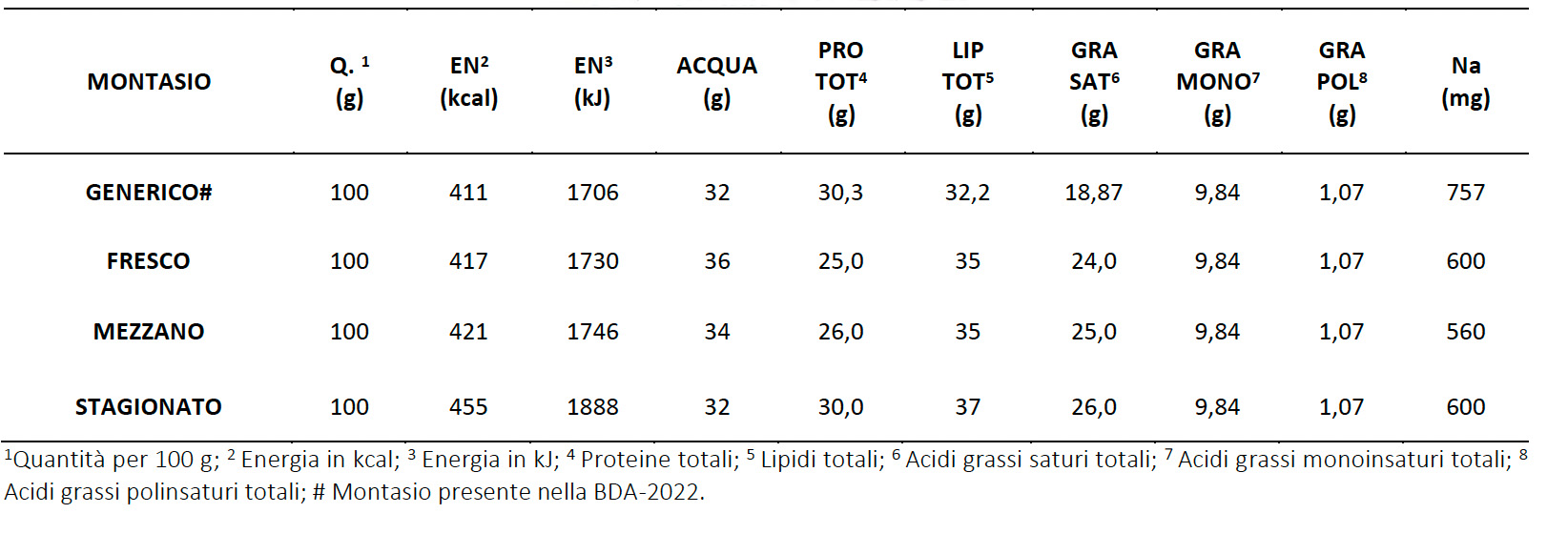
Nutritional values for Montasio “fresh”, “medium-aged”, and “aged” varieties compared with data from BDA-2022
A balanced diet includes the consumption of cheese because it can contribute to overall dietary balance. As a dairy product, cheese is rich in calcium and phosphorus, two of the most important nutrients for children during their growth phase, as well as for older adults who are prone to osteoporosis. Additionally, thanks to its quick energy supply, it is also an ideal food for athletes.
With Montasio PDO, everyone can enjoy their own moment of pure flavor.
The information in this article is intended for educational and informational purposes only. It is not a substitute for professional medical advice or guidance. For a personalized dietary plan suited to your specific needs, health status, or medical conditions, always consult your physician or a qualified nutritionist/dietitian.