Balanced Nutrition for Children Aged 8–9: How to Include Cheese in Their Diet

“What should I cook for my kids?” How many times have you asked yourself this question while shopping or planning meals? The ages between 8 and 9 are a period of rapid growth and high energy needs. Your child doesn’t just need to be fed — they need the right fuel to build strong muscles and bones, stay focused at school, and enjoy their everyday activities to the fullest.

Which nutrients are essential? What are the right portions? To answer some of the most common questions, the team of nutritionists from the University of Udine, in collaboration with the Montasio PDO Cheese Consortium, has developed a daily menu that follows the latest LARN (Reference Intake Levels) guidelines and ensures the perfect balance between science, taste, and quality.

Essential Nutrients for Children’s Growth

Proper dietary planning for school-aged children is based on rigorous scientific principles, essential for supporting optimal growth and development. Our approach aligns with the most recent LARN recommendations regarding energy and nutrient intake (5th revision, 2024) and relies on the nutritional values from the BDA tables (2022), with a particular emphasis on nutrient quality.

The energy needs of an 8- to 9-year-old child (approximately 1800 kcal/day) should be met through a varied diet that respects the correct distribution of macronutrients. In terms of daily frequency, it is crucial to ensure at least 5 servings of seasonal fruits and vegetables (i.e., 2–3 servings of fruit and 2–3 servings of vegetables) to provide essential fibers, vitamins, and minerals.

Regarding structural macronutrients, carbohydrates should provide 51% of total daily calories, fats 29%, and proteins 16%. These percentages may vary slightly depending on a child’s age and weight, as well as their level of physical activity.

Making meals enjoyable for children

The proposed meal plan includes Montasio PDO cheese in two main meals, favoring the fresh or semi-aged varieties:
– spiedino al Montasio
– tortino di spinaci e Montasio

In this way, by consuming controlled portions of Montasio cheese, it is possible to contribute to an adequate intake of protein, balanced fats, and calcium, while also promoting local food culture from an early age.


The information in this article is intended for educational and informational purposes only. It is not a substitute for professional medical advice or guidance. For a personalized dietary plan suited to your specific needs, health status, or medical conditions, always consult your physician or a qualified nutritionist/dietitian.

Bioactive Peptides and the Gut Microbiota: Results from a Scientific Study on Montasio PDO

Cheese is one of the most beloved foods in our culinary tradition, but also one of the most debated when it comes to diet and wellness. Between myths to debunk and accurate information, consumers often find themselves confused about its real benefits.

To shed light on the topic, the Montasio PDO Protection Consortium involved nutrition experts from the University of Udine to present the results of studies conducted on Montasio PDO cheese, focusing on digestive processes observed in laboratory settings and their interactions with microorganisms and bioactive molecules.

We interviewed Prof. Nadia Innocente, lecturer and project coordinator, and Prof. Marilena Marino to understand how Montasio cheese can positively influence our health.


What functional potential did you observe in Montasio DOP cheese? What are its benefits for our body?

Prof. Nadia Innocente, lecturer and project coordinator at the University of Udine, responds

We analyzed Montasio cheese at different stages of maturation, from 2 to 25 months, to determine whether small protein fragments known as bioactive peptides form during the aging process. These peptides are studied for their potential properties, such as antioxidant, antimicrobial, and antihypertensive activity, as well as for their possible positive effects on the gut microbiota.
Our goal was to understand whether Montasio also possesses this type of functional potential and how it changes over time.


What happens to peptides during cheese maturation?

Prof. Nadia Innocente, lecturer and project coordinator at the University of Udine, responds

During the aging process, the proteins present in the cheese are hydrolyzed by proteolytic enzymes, leading to the formation of small- and medium-sized peptides and amino acids. We observed that the amount of peptides increases gradually and reaches a peak particularly between 12 and 18 months of maturation.
Moreover, over time the average size of the peptides decreases, resulting in a higher proportion of smaller peptides, which are also those with the greatest potential bioactive properties.


Regarding antimicrobial activity, does Montasio cheese really protect against certain bacteria?

Prof. Nadia Innocente, lecturer and project coordinator at the University of Udine, responds

We tested the effect of the peptides on four well-known pathogenic microorganisms: Listeria, Staphylococcus aureus, Escherichia coli, and Salmonella.
The results of our laboratory tests show that Montasio peptides are capable of slowing the growth of some of these bacteria, particularly during the early months of aging.
This is a promising indication, consistent with what is already known for other types of cheeses.


Can Montasio DOP cheese be considered a source of probiotic microorganisms?

Prof. Marilena Marino, lecturer at the University of Udine, responds

Montasio cheese is certainly a natural source of potentially probiotic microorganisms.
What we observed is that lactic acid bacteria, which mainly come from the milk, are able to partially survive in the finished product. We also found that many of these bacteria, depending on the aging process, can reach the intestine alive, where they can positively interact with the human microbiota, improving microbial balance and immune function.
In this sense, Montasio, especially in its fresh or semi-aged versions, can be considered a “probiotic-like food” — a food that delivers live microorganisms with potential beneficial effects on the gut microbiota.


Is there a difference between Fresh and Aged Montasio in terms of microorganisms?

Prof. Marilena Marino, lecturer at the University of Udine, responds

Yes, there is a significant difference.
In fresh Montasio, lactic acid bacteria are still alive and active, playing a direct role: they can reach the intestine and “communicate” with the gut flora.
In aged Montasio, most microorganisms are no longer alive, but the cheese retains bioactive molecules, such as peptides, organic acids, and cellular components, which continue to exert positive effects. This is known as a “postbiotic” effect—benefits remain even when the bacteria are no longer alive.

In practice: fresh Montasio delivers live bacteria; aged Montasio delivers their beneficial traces.


What happens in our gut when we eat Montasio DOP cheese?

Prof. Marilena Marino, lecturer at the University of Udine, responds

During digestion, the proteins and fats in cheese are broken down, releasing small bioactive fragments and nutrients that reach the colon.
In the lab, we simulated this process and observed that Montasio residues stimulate the growth of beneficial bacteria such as Bifidobacterium, Faecalibacterium, and Blautia, all associated with a healthy gut.
We also observed a small but consistent increase in Akkermansia, a bacterium that helps maintain a strong intestinal barrier.
This means Montasio components can promote a more balanced and active gut flora, contributing to overall well-being.


The study highlighted how the presence of probiotic microorganisms and bioactive peptides in Montasio DOP cheese, at different aging stages, positively contributes to the modulation of the microbial community and its metabolic activity.

Choosing a PDO cheese like Montasio means introducing into your balanced diet not just a traditional product, but above all a food that can be part of a well-rounded diet, contributing essential nutrients that support gut health.


The information contained in this article, derived from a research and experimental project conducted by scientific experts, is intended for educational and informational purposes only. The results mentioned, particularly those concerning bioactive peptides and the microbiota, are based on preliminary in vitro analyses (i.e., conducted in the laboratory) and should not be interpreted as proven health claims for human consumption. For the development of a personalized dietary plan or for any guidance related to medical conditions, you are always advised to consult your physician or a specialized nutritionist/dietitian.
Montasio PDO Cheese in the mediterranean diet

Whether eaten as a snack, a main course, grated over pasta dishes or served as a dessert, cheese is a fundamental part of our diet — it’s a staple that never fails to appear on our tables.

Doctors, nutritionists, and health experts all agree: the consumption of milk and dairy products brings significant benefits to the body, thanks especially to their content of proteins, calcium, fats, vitamins, and essential minerals.

Following a varied and balanced diet, as recommended by the Mediterranean diet, can help maintain a healthy lifestyle in line with nutritional guidelines, while also supporting a more sustainable production model that values local supply chains. In this dietary pattern, cheese plays a central role.

What does a balanced diet mean?

A balanced diet doesn’t mean restriction — it means variety, moderation, and awareness. It’s based on the proper balance of macronutrients (carbohydrates, proteins, and fats) and micronutrients (vitamins and minerals), all essential for the body to function properly.

Following a healthy diet means:
– Ensuring the right amount of energy: by properly distributing macronutrients throughout meals
– Varying your food sources: alternating foods to ensure all necessary bioactive compounds are included
– Respecting portions: consuming foods in the right quantities and frequency, a key element of proper nutritional education

Diet plans should always be developed according to the nutrient and energy reference values defined by LARN (Reference Intake Levels of Nutrients, 5th revision 2024) and the Guidelines for Healthy Eating (CREA, 2018) — the two main documents for nutritional planning in Italy.

These guidelines state that energy needs must always be calculated by considering:
– Gender, age, and level of physical activity
– Physiological condition (e.g. pregnancy or athletic activity)
– Proper distribution of macronutrients

According to the same guidelines, the daily energy distribution among meals should be as follows:
Breakfast: 15–20%
Lunch: 35–40%
Dinner: 30–35%
Snacks: 10% (split between mid-morning and mid-afternoon)

How much cheese should you eat per week?

Experts recommend consuming milk and its derivatives — such as yogurt and ricotta — daily in portions of around 150–200 ml. Cheese, including Montasio PDO, should ideally be included 2–3 times per week (as suggested by CREA guidelines), ensuring variety among the protein sources in the diet.

However, recommendations regarding how much and how often cheese should be consumed can vary depending on several nutritional and clinical factors.

Compared to other sources of protein — like meat, fish, and eggs — cheese provides a higher nutrient density. For equal portions (100 grams), cheese contains about 25 grams of protein, whereas white meat and lean fish contain around 20 grams.

As a general guideline, the recommended portions vary depending on the cheese’s aging. For fresh cheese, the suggested portion is about 100 grams, while for aged cheese, the recommended portion is around 50 grams. However, aged cheese can be consumed daily if grated; for example, a sprinkle of aged cheese, such as Montasio Stravecchio, over pasta or risotto corresponds to approximately 10 grams.

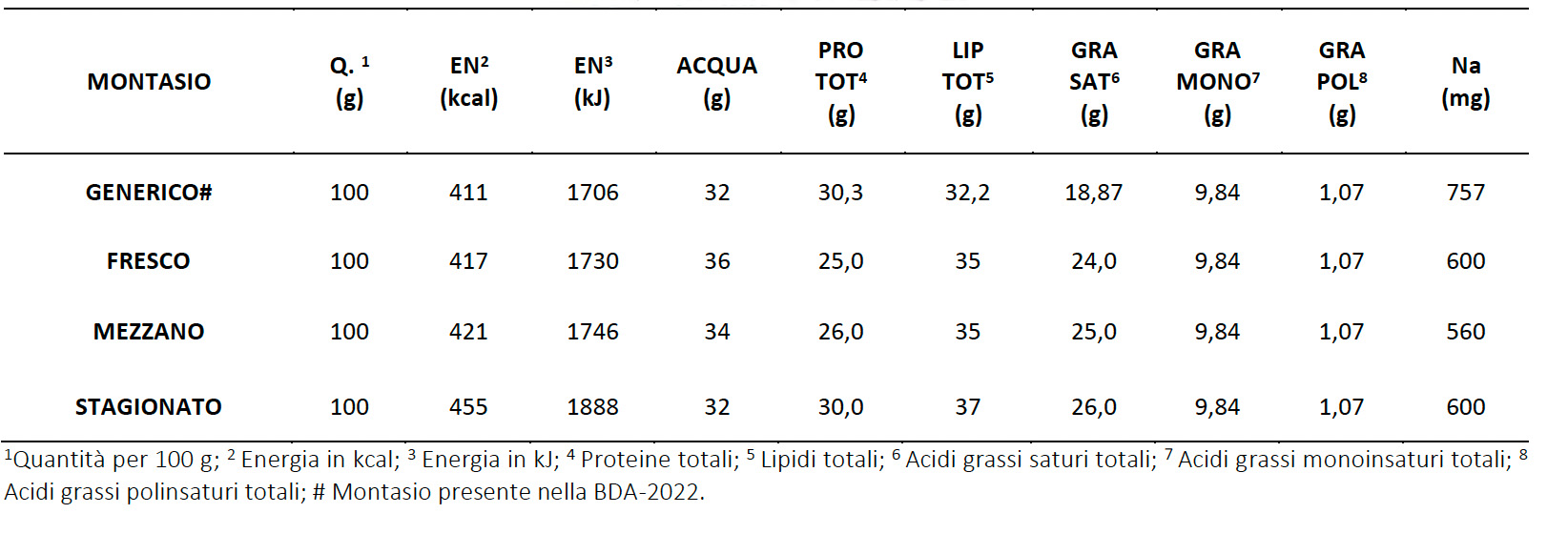
In addition, aged cheeses are more calorie-dense than fresh ones (as shown in the comparison table below), mainly because of their higher concentration of proteins, calcium, sodium, and vitamins.

Nutritional values for Montasio “fresh”, “medium-aged”, and “aged” varieties compared with data from BDA-2022

Nutritional values for Montasio “fresh”, “medium-aged”, and “aged” varieties compared with data from BDA-2022

A balanced diet includes the consumption of cheese because it can contribute to overall dietary balance. As a dairy product, cheese is rich in calcium and phosphorus, two of the most important nutrients for children during their growth phase, as well as for older adults who are prone to osteoporosis. Additionally, thanks to its quick energy supply, it is also an ideal food for athletes.

With Montasio PDO, everyone can enjoy their own moment of pure flavor.


The information in this article is intended for educational and informational purposes only. It is not a substitute for professional medical advice or guidance. For a personalized dietary plan suited to your specific needs, health status, or medical conditions, always consult your physician or a qualified nutritionist/dietitian.